
Effective date: 15 Jul 2019
Revision date: 15 Dec 2019
Introduction
Somalia is a high-risk environment in which employees, contractors, and clients are exposed to the associated risks and hazards of the environment. The International Campus (IC) in the Mogadishu International Airport area (MIA), provides accommodation and life support services to a wide range of personnel and missions.
Security procedures and guidelines must be known to all personnel in order to ensure the security function and safety of all guests and personnel residing in the International Campus (IC).
Aim
The aim of this document is to provide guidelines to guests at the International Campus (IC) regarding general security matters and the reaction to security-related incidents.
Scope
The following items will be addressed:
- General
- Access Control
- Emergency Procedures
- Location of Muster Points
General
The African Skies Limited (ASL) Security Manager is responsible for managing all security related issues in the IC. In the event of an emergency, he will take control of the situation and issue orders to security personnel and clients. In his absence, the Deputy Security Manager Manager will take over his duties. These members can be contacted 24/7 on the following numbers:
- Security Manager: 061 700 7475 or
- Deputy Security Manager: 061 786 3602
- Camp Manager: 061 562 3173 or 0699 201 496
Access Control
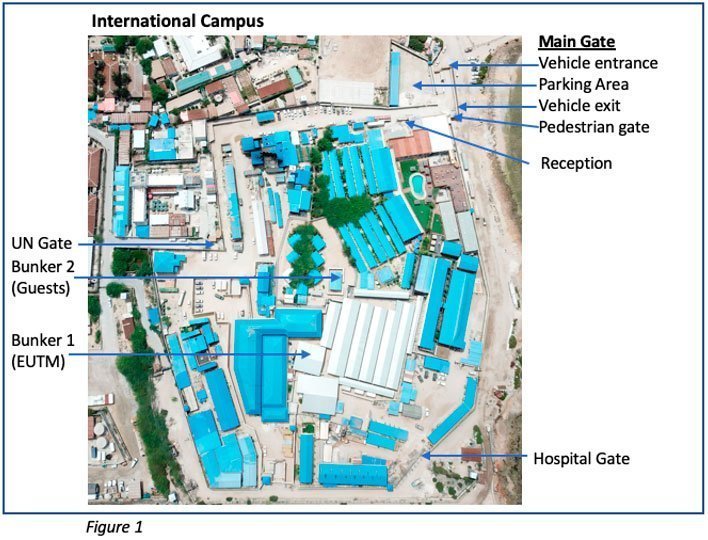
- Access to IC is gained through the following points:
- Main Gate (Entrance and exit)
- UN Gate (At the rear of compound adjacent to the UN)
- Hospital Gate (Adjacent to the AMISOM watchtower) Only used by EUTM, Carabinieri, EUCAP and emergency vehicles.
- All pedestrians (residents and visitors) must make use of either the main or the United Nations (UN) gate as the only points of entry and exit. Only persons with a UN ID will be allowed to enter the UN camp through the UN gate.
- No alcohol will be allowed into the IC.
- All clients authorized to enter the IC with their weapons must unload their weapons in the clearing barrels situated at all entrances.
- No visitors are allowed to enter the IC with weapons. See attached weapons posture.
- All residents, guests, and visitors will be issued with ID cards as follows:
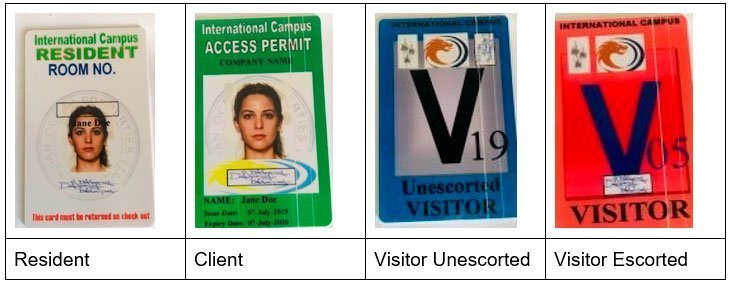
- Residents are issued with photo ID’s.
- Permanent clients are issued with green photo ID’s.
- UN visitors will be issued with a blue visitors badge at either the UN or the main pedestrian gate when entering the IC. They will be required to swap their UN ID for this blue visitors badge and the reverse will take place when exiting the IC. See attachment for example.
- Escorted visitors to the IC must be met at the main entrance gate by the host and escorted to reception where a red visitor’s badge will be issued. The host takes responsibility for the visitor that he/she signs in and is responsible to escort the visitor at all times until they exit the IC.
- All visitors must be present when signing in at reception. No one is allowed to sign in on behalf of someone else.
- In the event of an unexpected visitor, the visitor will be required to contact his/her host who will meet the visitor at the main gate, escort him/her to reception to be issued with a red visitor’s badge. The host must escort the visitor when he/she leaves the IC.
- A visitor will be issued a Visitor ID card and his personal ID card/passport will be kept at reception and be handed back when the visitor signs out. Visitor ID cards need to be displayed at all times.
- Visiting hours will strictly be between 07:00 and 23:00. Non-adherence to the rules will lead to disciplinary procedures or barring from entry to the IC in the future.
- Residents must ensure that all visitors have their contact details, as the guard force will not act as messengers to locate residents.
- The guard force will use discretion concerning high profile African Union Mission in Somalia (AMISOM) visitors to the camp and inform.
- No visitor will be allowed to enter the camp between 20:00 and 07:00, unless prior arrangement has been made with the ASL Camp Manager or ASL Security Manager.
- Any visitor entering the camp will be subject to a body search and search of their personal belongings at the discretion of security personnel.
- All vehicles must enter the IC through the allocated vehicle entrance gates.
- All vehicles will be stopped and searched at the vehicle entrance gate before entering the IC. The driver and passengers will have to identify themselves by showing their ID’s and everyone will be searched by wand or walk through the scanner.
- Emergency vehicles that need access to the EUTM Role II hospital will be allowed access through the Hospital Gate.
- All vehicles that make use of the Ocean Gate to access the parking area in front of the EUTM Role II hospital must first stop at the main entrance to the IC where they will be searched. After the vehicles have been cleared, they will be allowed to enter through the Hospital Gate. Visitors of the units located in the area behind the Hospital Gate must make use of the main gate to enter the IC and will not be allowed to enter through the Hospital Gate.
- Overnight guests will be dropped off at the Main Gate and their booking will be confirmed with reception. They will proceed to reception where they will be registered, issued with Guest ID cards and taken to their room(s).
Emergency Procedures
Fire
In the event of a fire anywhere within the camp, you are to carry out the following procedure:
- If you discover the fire, sound the alarm by shouting “fire, fire, fire” and attempt to alert all personnel in the immediate vicinity.
- Do not put yourself at risk by re-entering the building.
- Move away from the fire to an open, ventilated area.
- Guards and ASL staff will attempt to put out the fire.
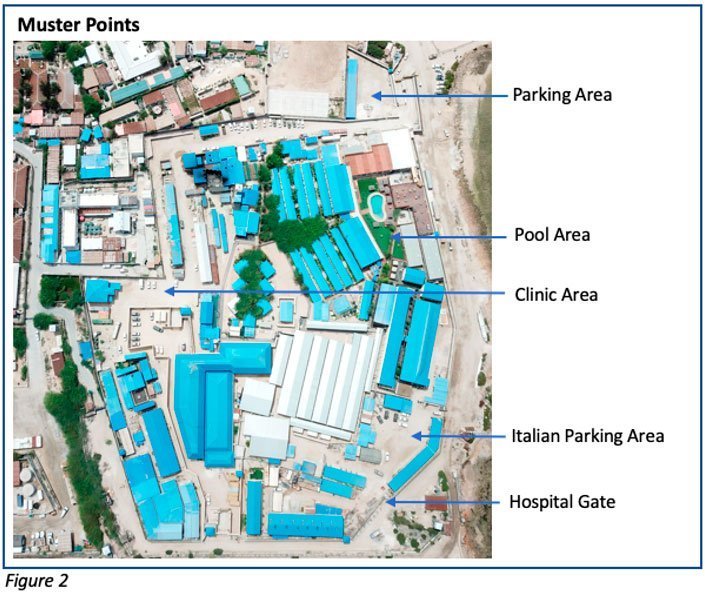
- If the fire cannot be brought under control, the siren will be activated and an announcement “proceed to the muster point” will be made. Use the closest muster point to your current position (Refer Figure 2 below) If a muster point is unavailable, the next muster point must be used.
- Signs indicating the fire escape routes to the muster points are present throughout the IC and security will assist during a fire.
- The primary muster point is outside the camp between the main gate and the pedestrian gate and the secondary muster point is the open area in front of the Clinic Area.
- Be aware that personnel will arrive to tend the fire.
- There is a 24/7 “Fire Watch” within the camp carried out by the patrolling guards.
- During your stay please take a moment to familiarise yourself with the location of the muster points; paying particular attention to the different fire escape routes as indicated by the signs.
Attack
The procedures outlined below are generic and apply for all types of attacks. Actions in the immediate aftermath may vary and could include dealing with shocked and injured people, evacuation to a safe area and the arrival of armed police and military. The procedures described below will also be followed in the event where information is received indicating an imminent threat against the IC and its residents.
- ASL security personnel will raise the alarm verbally or the siren will be activated (a continuous tone) followed by an announcement, “take cover”.
- On hearing the siren (a continuous tone), or being aware of a terrorist situation, put on your body armor (if available) and take cover. Department of State (DoS) clients will stay in the DoS bunker (See picture below) When it is deemed safe, the siren will be activated again (a continuous tone) followed by an announcement “proceed to the bunker”. Clients must follow their company/agency’s procedures, should it differ.
- Bunker one is for European Training Mission (EUTM) personnel and bunker two for non-EUTM personnel. (Refer to Figure 1 for bunker locations)
- If you approach the bunker unescorted, make sure to have your arms in the crucifix position with the palms facing forward. This is to indicate to the personnel controlling the bunkers that you are unarmed and for identification purposes. Stop at least 10 meters from the bunker, identify yourself and wait for further instructions.
- ASL security personnel will continue with their allocated tasks.
- The EUTM personnel will ensure the safety of bunker one and the UK British Forces that of bunker two. There will be five ASL guards guarding the traditional mess where all the Ugandan staff will gather.
- The heads of the different agencies resident in the IC at the time will be responsible to account for all personnel and report the status to the ASL camp manager.
- If medical treatment is required, the injured will be moved to the Role II hospital.
- Further actions will be dictated by the situation, but may include:
- Lockdown of the camp
- Evacuation of the camp
- Dealing with a bomb blast or a suspected device
- Dealing with hostile or suspect individuals within the camp
- Note: An “all clear” announcement will be made on the PA system to indicate that guests can return to their accommodation/areas of work.
- Additional Notes
- The situation may dictate a controlled evacuation of the camp to a secure secondary location. This may also include the evacuation of casualties.
- If the camp is evacuated, IOP/ASL may have to relinquish control of the situation to AMISOM. To that effect, Bancroft/ASL cannot guarantee the security of personal equipment such as laptop computers, cameras, cellular phones, etc.
Following an incident, the site will be “swept” to ensure that the area is safe. The site is to be cordoned off in the event that the AMISOM forces need to gather intelligence.
Indirect Fire Attack
During an indirect fire attack (Mortars, rockets) there might be little to no early warning. If the early warning is received or during an incident, the siren will be activated (A continuous tone) followed by an announcement “Take cover”. The following points are relevant:
- The immediate priority on attack will be to get under hardcover or overhead protection.
- Move to a bunker and stay in the bunker until the “All clear” is sounded. (Refer to Figure 1 for bunker locations)
- If a bunker is too far, move to overhead protection such as a concrete roof with lateral walls to provide secondary protection against fragments. Stay until the “All clear” is sounded.
- Stay away from windows.
- Report to your location and situation to your department head, representatives of agencies will give a status report to the security manager.
- Casualties as per attack procedure.
A. OLIVIER
SECURITY MANAGER, INTERNATIONAL CAMPUS.